
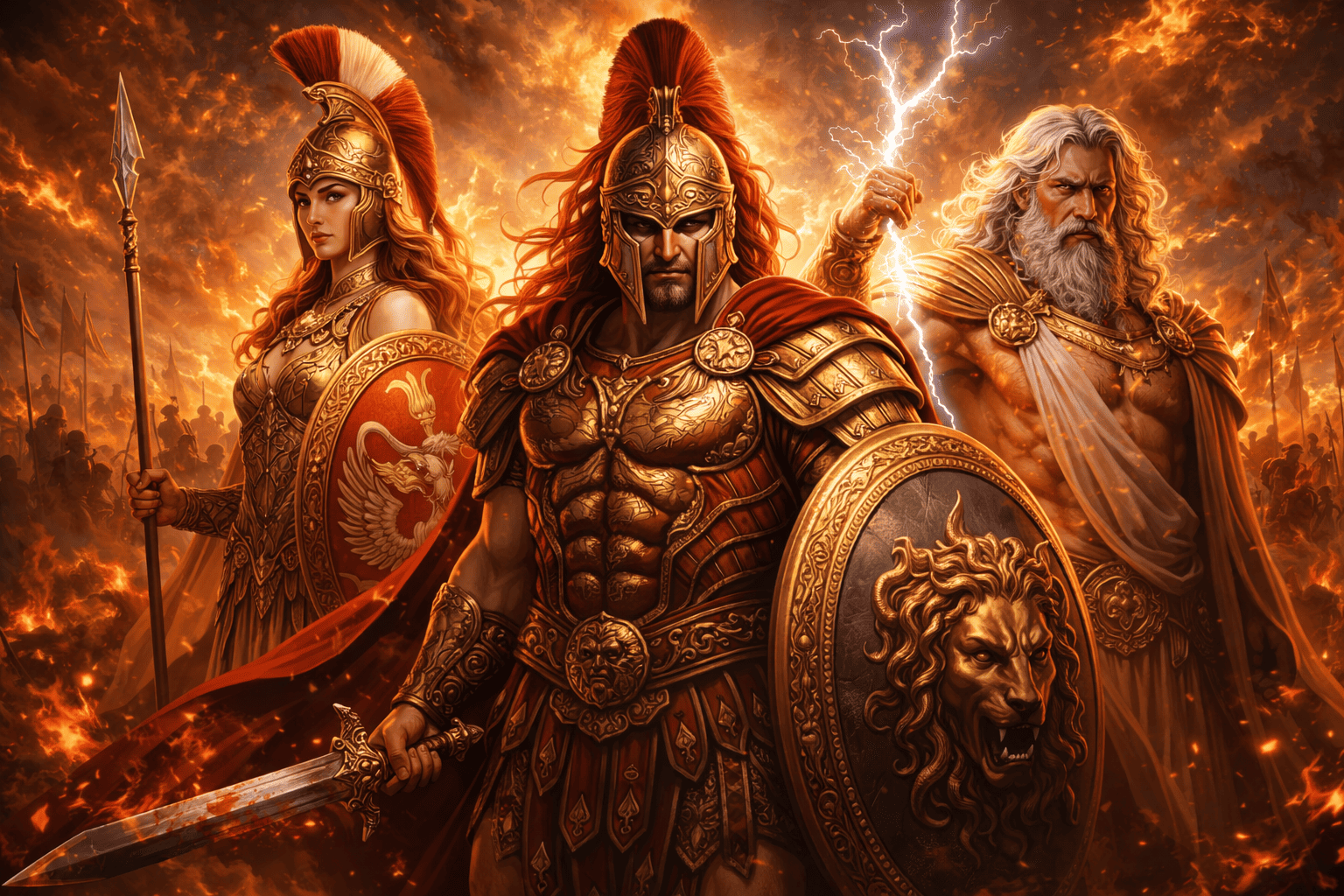
War in ancient Greece was never just about clashing spears and marching armies—it was a force that shaped cities, families, and even the gods themselves. When people talk about the god of war in Greek mythology, they often picture brute strength and fury, but Greek stories paint a more complicated portrait. Conflict could be savage, strategic, protective, or even necessary for justice. That’s why multiple deities became tied to warfare in different ways, with each myth revealing what the Greeks feared, admired, and debated about violence. At the center of this divine battlefield stand two unforgettable figures: Ares, the embodiment of raw combat, and Athena, the mind of war’s discipline.
Ares: The Roar of Combat Itself
If you want the purest image of battle’s chaos, you meet Ares god of war. As an ares god, he represents the loud, dangerous side of conflict—bloodlust, momentum, and the unpredictable swing of fate. In stories, Ares is not always praised; he’s often portrayed as terrifying and reckless, the kind of power that can win a fight but ruin a cause. That tension is important: Greek mythology doesn’t romanticize war as noble by default. Ares shows what happens when violence is unrestrained, when anger becomes its own reason.
Yet Ares isn’t simply “evil.” He’s honest about what war feels like on the ground: panic, courage, cruelty, and adrenaline all at once. His presence in myth reminds audiences that battle can be irresistible to those who crave glory, but that glory comes with a cost. Even when he is defeated or mocked, he remains necessary to the Greek imagination—because war, however hated, was real.
Athena: Strategy, Protection, and the Rules of War
Where Ares is the storm, Athena is the shield wall holding steady. Many readers know her as a wise deity, but she also belongs in any conversation about warfare because she embodies organized conflict—planning, discipline, and defense. The phrase athena war goddess captures this role, but her identity goes deeper than a simple title. Athena’s wars are fought with purpose: to protect a city, to uphold justice, to preserve order when chaos threatens to swallow everything.
This is why the idea of athena god of war and wisdom makes sense. In Greek storytelling, wisdom isn’t separate from conflict; it shapes how conflict is used. Athena teaches that victory can depend on patience, alliances, and restraint—qualities that feel almost like opposites of Ares. When myths place them near each other, they create a debate: is war a wild force that sweeps people away, or a tool that must be controlled?
Why Greek Myth Has More Than One “War God”
It’s tempting to look for a single answer to “Who is the war god?” But Greek myth often splits a big idea into multiple divine faces. That’s the key to understanding the god of war in Greek mythology: it’s not only one personality. War contains violence and bravery, but also planning and politics. Ares and Athena represent different truths, and the Greeks seemed to understand that both can appear in the same battle.
In many tales, heroes succeed not by choosing one side completely, but by recognizing what the moment demands. A soldier might need Ares’s fearlessness in the charge—and Athena’s clarity when making a life-or-death decision. Myth turns this into symbolism: the gods aren’t just characters; they’re mirrors for human choices.
War Beyond the Battlefield: Fear, Honor, and Fire
Greek myths also show that war doesn’t end when the fighting stops. It follows survivors home as trauma, pride, revenge, and grief. Temples, festivals, and stories kept war present in the cultural memory, asking communities to process what they had done and what they had lost. Even the gods reflect that aftermath: Ares is the wound that still throbs, Athena the effort to rebuild and govern.
And sometimes myth expands war’s imagery into elemental power—heat, smoke, and destruction—making conflict feel like a force of nature. If you’re exploring connected themes for your mythology series, it’s easy to move from Ares and Athena into the idea of god of war fire gods, where battle becomes not only a clash of wills but a blazing symbol of transformation and ruin.
Conclusion
Greek mythology treats war as both a warning and a reality. Through Ares god of war, the myths expose battle’s frenzy and danger, while athena war goddess reveals the disciplined, strategic side that can defend communities and uphold order. Seeing athena god of war and wisdom beside an ares god reminds us that conflict has multiple faces—some necessary, some devastating, all deeply human. In the end, the god of war in Greek mythology isn’t just a single name; it’s a conversation about power, choice, and what people become when peace breaks.