
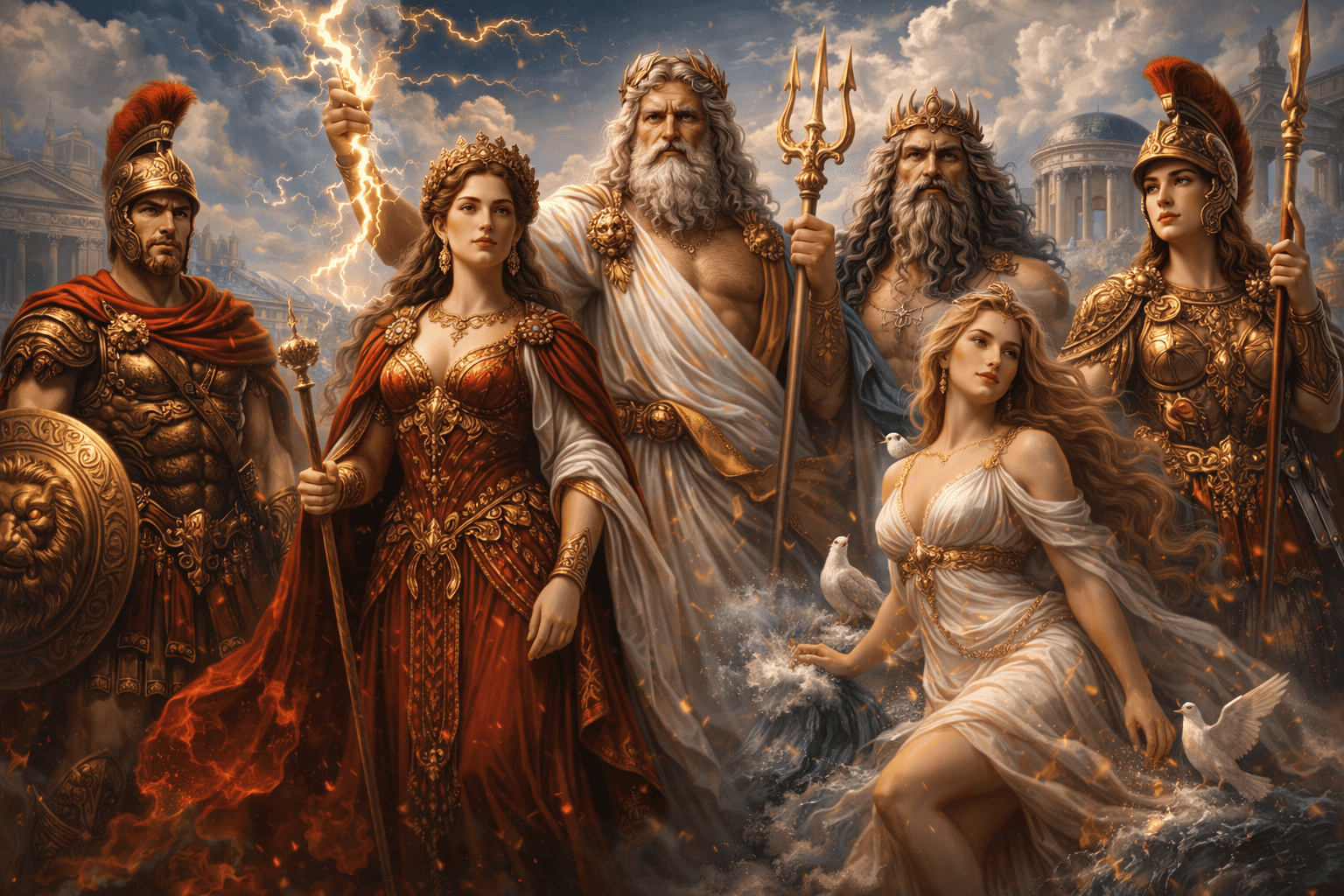
Myths were never just entertainment in Rome—they were explanations, warnings, and civic memory. The roman mythology gods embodied what Romans admired and feared: duty and discipline, desire and excess, storms at sea, and the fragile luck of daily life. Roman religion also absorbed stories from across the Mediterranean and reshaped them into something distinctly Roman—public, practical, and tied to ritual. Exploring the ancient roman gods isn’t only about names and symbols; it’s about how Romans pictured order in the world, and what they believed kept families, cities, and empires standing.
The Pantheon as a Civic System
Rome’s divine world was woven into public life. Festivals filled the calendar, temples stood at political crossroads, and vows to the gods accompanied elections, harvests, and military campaigns. Many Romans focused less on private belief and more on correct practice—performing rites properly so the community remained in harmony with the powers that governed it.
At the top stood Jupiter, whose authority echoed Roman ideals of law, stability, and sworn obligation. You’ll sometimes see him miswritten as god jupitiar, but the meaning is clear: the sky-father whose thunder underlined the seriousness of oaths and treaties. Around him were deities that shaped Rome’s public identity—Juno’s guardianship of marriage and state, Minerva’s strategic wisdom, Mars’s disciplined force, and Venus’s persuasive allure. Together, the divine felt like a model of Roman society: a place where roles mattered, order mattered, and every promise carried weight.
Bacchus and Dionysus: Delight with a Dangerous Edge
Few figures reveal Roman cultural tension as sharply as Bacchus. The Romans linked him to the Greek Dionysus, so the phrase bacchus and dionysus points to a shared mythic personality: a god of wine, theater, ecstasy, and transformation. In Rome, Bacchus could be praised as a giver of joy and feared as a force that dissolved social rules too completely.
Bacchic stories ask what happens when order loosens—when the respectable citizen drops the polished mask of propriety, when celebration turns wild, when emotion outruns restraint. That fear wasn’t only moral; it was political. Rome relied on hierarchy and self-control, so a god who invited people to step beyond their roles could seem threatening. Yet Bacchus endured because he expressed a truth strict cultures often struggle to admit: humans need release. In myth, that release can heal grief, renew community, and remind a city that joy is also a kind of survival.
Gods of Sea and the Everyday Sacred
Because Rome’s power depended on shipping lanes and coastal trade, the gods of sea mattered intensely. Neptune is the best-known ruler of waves and storms, but Roman practice also honored protective sea powers tied to particular ports and coastlines. For sailors and merchants, a safe crossing could feel like a divine gift, and offerings before departure were as practical as securing a sail.
Roman religion also addressed ordinary survival. Janus watched doorways and beginnings; Vesta guarded the hearth; Mercury oversaw travel and commerce. These gods weren’t abstract ideas—they were present in contracts, meals, and journeys. In Rome, myth and routine met constantly: a public sacrifice to Jupiter might be followed by a quiet household prayer for health, steady work, and a safe return home. The sacred was not far away; it was stitched into daily decisions, from opening a shop to sending a loved one across the sea.
Roman Adaptation and a Glance Toward Norse Legends
Rome rarely erased a story; it adapted it. As the empire expanded, it met new deities through conquest, diplomacy, and trade. Local gods were identified with Roman counterparts, imported rites were regulated, and familiar myths were retold in a Latin voice. This flexibility helped Rome govern diverse peoples, but it also created a mythic mosaic where one divine figure could wear many regional faces while still fitting into Roman categories of duty, protection, and power.
Comparing Roman storytelling with norse legends highlights what’s uniquely Roman. Norse tales often lean into heroic struggle, looming fate, and a cosmos marching toward catastrophe. Roman myth, by contrast, tends to emphasize negotiated order, civic continuity, and the belief that careful ritual can keep the world aligned. Both traditions are vivid, but Roman myths frequently sound like the voice of a city asking, “What must we do—together—to keep everything holding?”
Conclusion
The roman mythology gods were more than dramatic characters; they were anchors for a civilization that believed divine favor and public fortune were intertwined. Jupiter’s oath-bound authority, Neptune’s unpredictable waters, Mercury’s fast-moving bargains, and Bacchus’s unsettling joy reveal a culture balancing discipline with desire and tradition with change. To study the ancient roman gods is to see how myth can function like a social blueprint: it teaches what a community values, what it fears, and what it hopes the divine will protect. And even now, these stories still echo—because they speak to familiar questions about power, responsibility, and the thin line between order and chaos.