
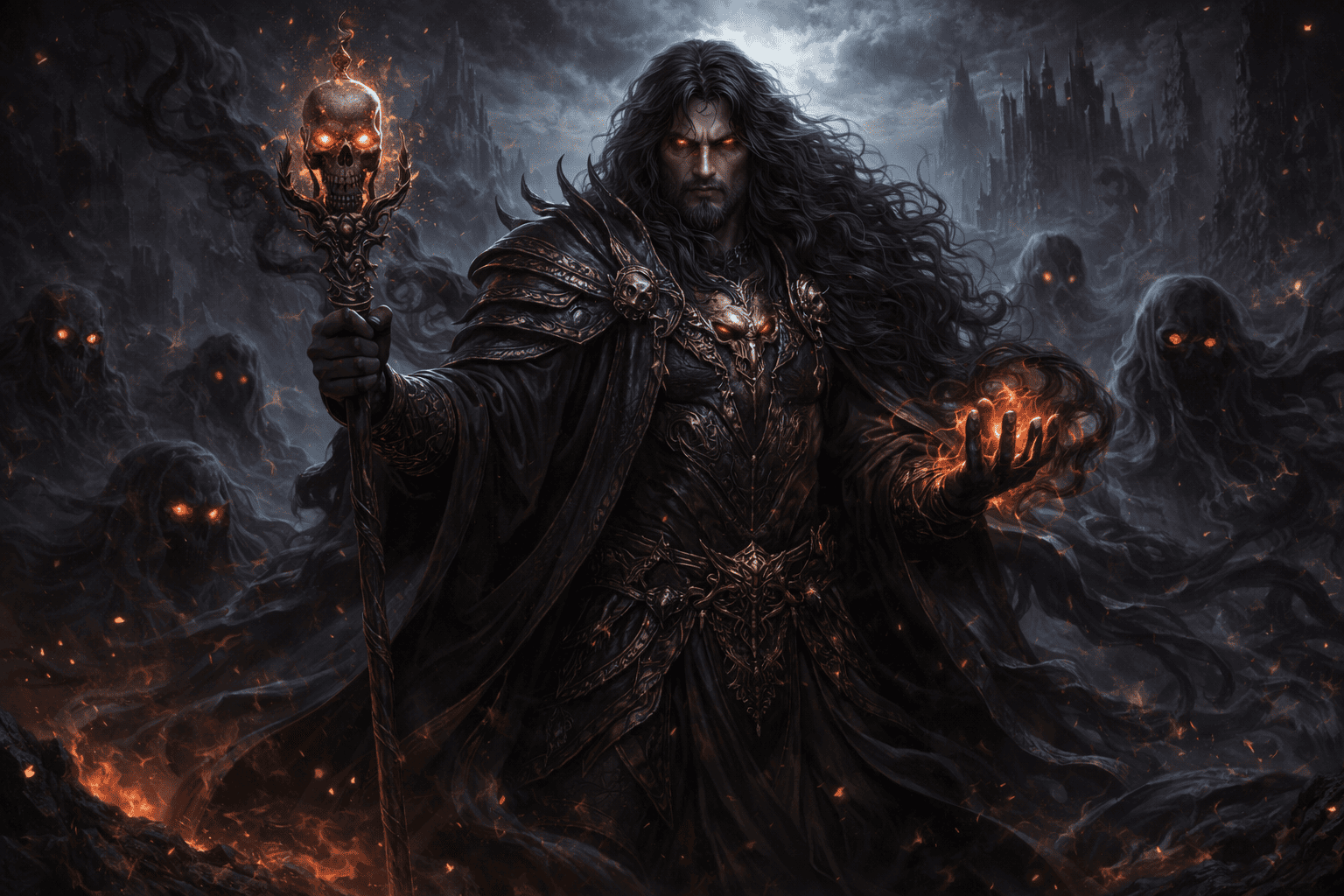
In the oldest Greek stories, before Olympus had thrones and before heroes had names, the universe began with forces rather than faces. One of the most haunting of these is Erebus—darkness not as a mood, but as a living presence. In erebus greek mythology, he represents the deep shadow that fills the spaces between beginnings, a primeval gloom that existed before daylight had a language. Erebus is often paired with Nyx, the night herself, and together they form a boundary between what is known and what is feared. To understand Erebus is to step into the mythic idea that darkness isn’t merely the absence of light—it is an origin.
Who Is Erebus in the Earliest Greek Tradition?
Erebus appears in the earliest Greek cosmogonies as a primordial entity, one of the first realities to emerge after Chaos. Unlike later gods with temples, rivalries, and epithets, Erebus is closer to a cosmic condition—an embodiment of deep darkness and underworld shadow. In many tellings, Erebus is not a ruler with a crown but a region and a being at once: the thick gloom that dwells in the depths beneath the earth.
This is why references to Erebus often feel architectural. He is part of the universe’s structure, a layer of existence that must be crossed. When poets speak of descending into the world below, they describe not just an underworld of souls, but a darkness so heavy it becomes a threshold. That threshold is Erebus.
Erebus and Nyx: Night’s Shadowed Counterpart
A key relationship in these myths is erebus nyx—Erebus and Nyx, darkness and night, paired in a way that suggests the ancients saw them as complementary forces. In some accounts, they produce luminous opposites: Aether (upper air, brightness) and Hemera (day). The symbolism is striking: from darkness and night come day and light, as if creation itself is a cycle of contrasts.
This pairing also gives Erebus emotional texture. Nyx often feels active and watchful in myth; Erebus feels vast and still. Together, they explain how the Greeks imagined the rhythm of the cosmos: darkness is not an accident, but a foundational element that makes the return of light meaningful. Erebus is the deep ink that allows dawn to stand out.
Darkness, the Underworld, and the Misleading “God of War” Label
Erebus is frequently associated with the underworld, but it’s important to separate him from later underworld rulers and judges. He is not Hades, nor a punisher, nor a keeper of laws. Erebus is the darkness that lies in the chasm—older than the courts of the dead, older than the idea of moral accounting. If Hades is a realm with order, Erebus is the ancient shadow that makes that realm feel infinite.
This is also where modern misunderstandings creep in. You may occasionally see the phrase erebus god of war, but that label doesn’t fit the classic Greek role of Erebus. War in Greek myth belongs to deities like Ares, or to strategic figures like Athena. Erebus, by contrast, represents the primal unknown—an atmosphere that can surround conflict, but not a divine patron of battle. If darkness “fights” at all, it does so silently, by swallowing certainty and blurring the edges of what people think they understand.
Still, the mislabel reveals something interesting: modern audiences often try to categorize every figure by familiar domains—love, war, harvest, sea. Erebus resists that approach because he belongs to the mythic “before,” where categories haven’t formed yet.
Erebus Across Cultures: Echoes in Roman Gods and Beyond
Even though Erebus is Greek in origin, the idea of a primordial darkness appears across ancient traditions. When Greek stories blended with Roman storytelling, parallels were drawn between Greek cosmic powers and roman gods, sometimes as direct equivalents and sometimes as symbolic relatives. Roman myth and philosophy had their own ways of describing the underworld and the deep darkness below the world of the living, and later writers often used Greek names like Erebus as poetic shorthand when discussing Roman concepts of the afterlife.
This cultural echo matters because it shows how powerful the image is: the descent into shadow, the passage through a dim threshold, the sense that beneath civilization lies something older. Whether a tale is told in Greek verses or Roman retellings, darkness remains a necessary stage in the human imagination—where fear, transformation, and revelation can happen.
Conclusion
Erebus endures because he represents more than a character—he represents a condition the ancients believed was essential to existence. In erebus greek mythology, he is the deep darkness that predates gods, heroes, and even daylight, a reminder that mystery comes first. The pairing of erebus nyx highlights the mythic logic that opposites give birth to each other, and the occasional misuse of erebus god of war shows how easily modern labels can flatten older, stranger ideas. When later traditions, including stories of roman gods, borrowed or echoed Erebus as an image, they confirmed his lasting role as the shadowed doorway in the mythic world. To read about Erebus is to remember that every dawn begins in a darkness that once had a name.