
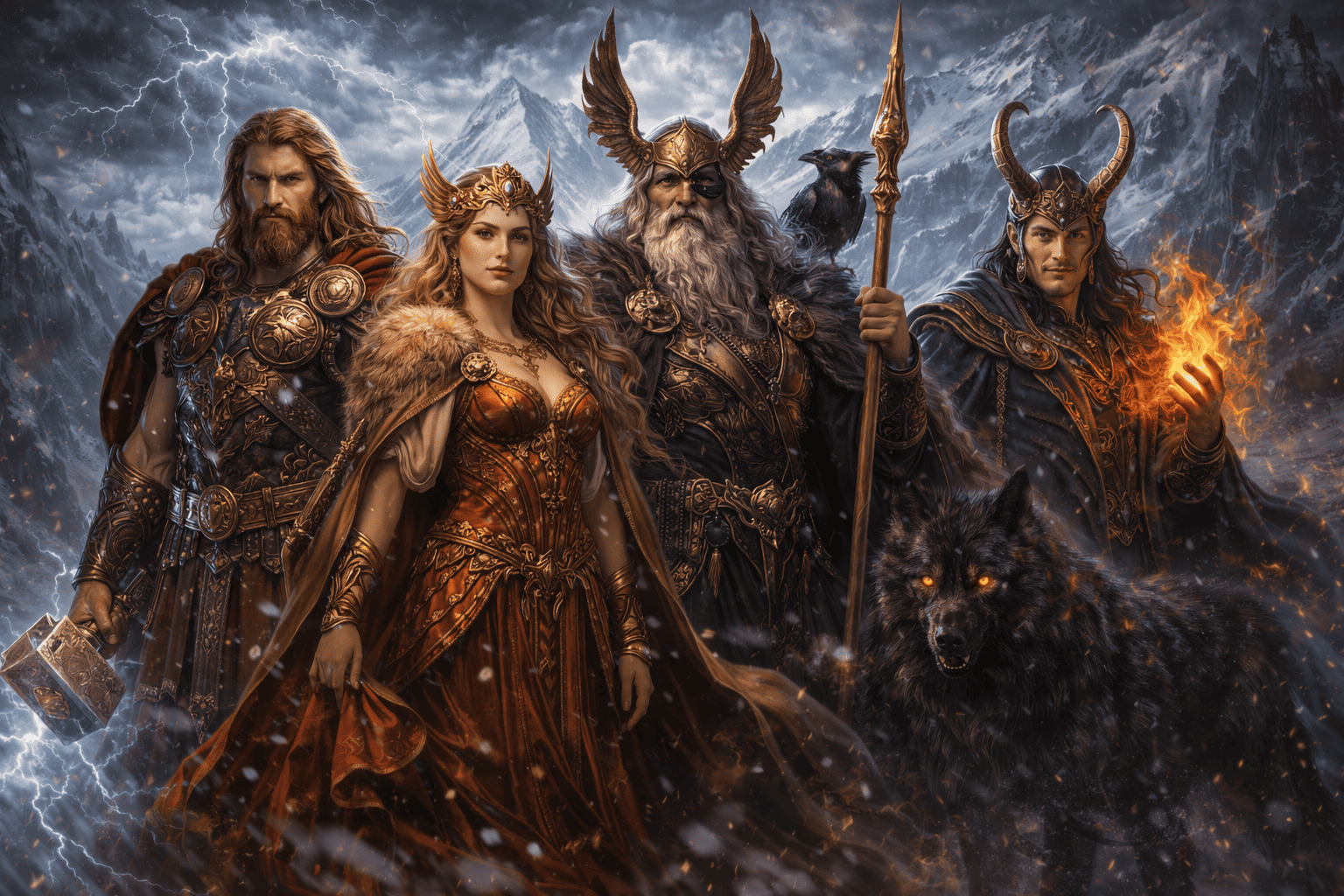
Norse legends have a rugged, wintry beauty: the clang of iron, the creak of longships, and the hush of northern forests where anything might be listening. Born in a world of fjords and firelight, these tales explain not only how the cosmos was made, but how courage is measured when the end is always somewhere on the horizon. From the halls of the gods to the icy roads of giants, norse legends and myths offer heroes who fail, monsters who bargain, and prophecies that refuse to be avoided. Read them as adventure, and you’ll find thunder and trickery. Read them as wisdom, and you’ll discover a culture asking the same questions we do: What do we owe our families, our communities, and ourselves when destiny doesn’t promise a happy ending?
The Northern Cosmos: Nine Worlds and One Final Day
In many nordic myths and legends, the universe is not a calm, orderly place—it’s a living structure under pressure. At the center stands Yggdrasil, the world tree, whose roots and branches connect the Nine Worlds. This cosmic map is less like a perfect circle and more like a web of relationships: gods depend on nature, humans depend on gods, and giants challenge everyone’s claims to power. The tension matters because the stories insist that balance is temporary.
This is why norse mythology legends feel so urgent. Prophecy is not a footnote; it’s the drumbeat. Even the gods know that Ragnarök—the final battle—waits ahead, and yet they still build, feast, argue, love, and fight. Rather than denying fate, the tales ask what it means to act with honor inside it. That idea shows up again and again in viking legends: you can’t always control the outcome, but you can control how you meet it.
And because the cosmos is layered, journeys often become tests of identity. A traveler moves between worlds and returns changed—wiser, wounded, or haunted. That theme resonates beyond the north, too. If you’ve ever been moved by the tragic devotion in orpheus and eurydice, you’ll recognize the same ache in Norse stories: love and loyalty can be brave, but they can also be fragile when confronted by the laws of the underworld.
Gods with Flaws: Power, Pride, and Paradox
The gods of the north are not distant perfection. They are powerful, yes—but also impulsive, jealous, stubborn, and occasionally ridiculous. Odin seeks knowledge at terrifying cost, bargaining pieces of himself for a wider view of reality. Thor, the thunderer, protects the realms with brute strength, yet his greatest battles often reveal how easily strength can be manipulated. And Loki—trickster, companion, saboteur—stands at the heart of the mythology’s most uncomfortable questions. Is chaos an enemy, or a necessary ingredient in change?
This complexity is part of why norse legends and myths remain vivid. The gods embody forces of nature and society, but they also embody human contradictions. Odin’s wisdom can look like obsession. Thor’s protection can slip into rage. Loki’s cleverness can turn cruel. These are stories that refuse simple morals. Instead, they show how power amplifies personality.
Even the “monsters” are layered. Giants are not merely villains; they are ancient rivals, representing wilderness, winter, and untamed strength. Sometimes they are foes, sometimes in-laws, sometimes uneasy allies. The borders between gods and giants can feel less like a wall and more like a storm front—shifting, dangerous, and impossible to ignore.
This is also why norwegian myths and legends often feel grounded. They aren’t floating fables; they mirror the real world’s harshness and uncertainty. Oaths matter. Reputation matters. Family lines matter. But no one is safe from consequence—not even the divine.
Heroes, Voyages, and the Meaning of Courage
While the gods thunder overhead, human heroes move through the shadows of those larger forces. Many viking legends celebrate explorers, warriors, and kings, but beneath the action is a philosophy: courage is not the absence of fear; it’s the decision to act anyway. A hero may know the odds are terrible and still choose the difficult path because it is right, or because it is necessary, or because it honors an oath.
That outlook gives norse mythology legends their distinctive tone. Triumph is sweet, but it is rarely permanent. Victory can be followed by vengeance. Glory can be followed by grief. And even the greatest deeds may only delay the inevitable. Yet the stories do not sink into despair—they insist that meaning is forged in the struggle itself.
This perspective helps explain why these tales traveled so far and lasted so long. They offered comfort without softness: the world is dangerous, but you can be brave within it. The sea may swallow ships, winter may swallow crops, enemies may arrive without warning—still, community and courage are worth building. That blend of realism and wonder is at the heart of nordic myths and legends, and it’s why they still feel relevant now, in any era where people must face uncertainty with grit.
Conclusion
Norse legends are more than old stories—they’re a worldview carved into myth. They present a universe of intertwined realms, flawed gods, and human lives lived under the shadow of prophecy, where bravery is measured by choices, not outcomes. Whether you come for the thunder, the trickery, or the haunting beauty of endings that cannot be escaped, norse legends and myths reward you with depth: they ask how to live honorably in a world that doesn’t promise fairness. Like all enduring mythology, they remind us that even when fate is fixed, meaning is made—one oath, one voyage, one hard-earned act of courage at a time.