
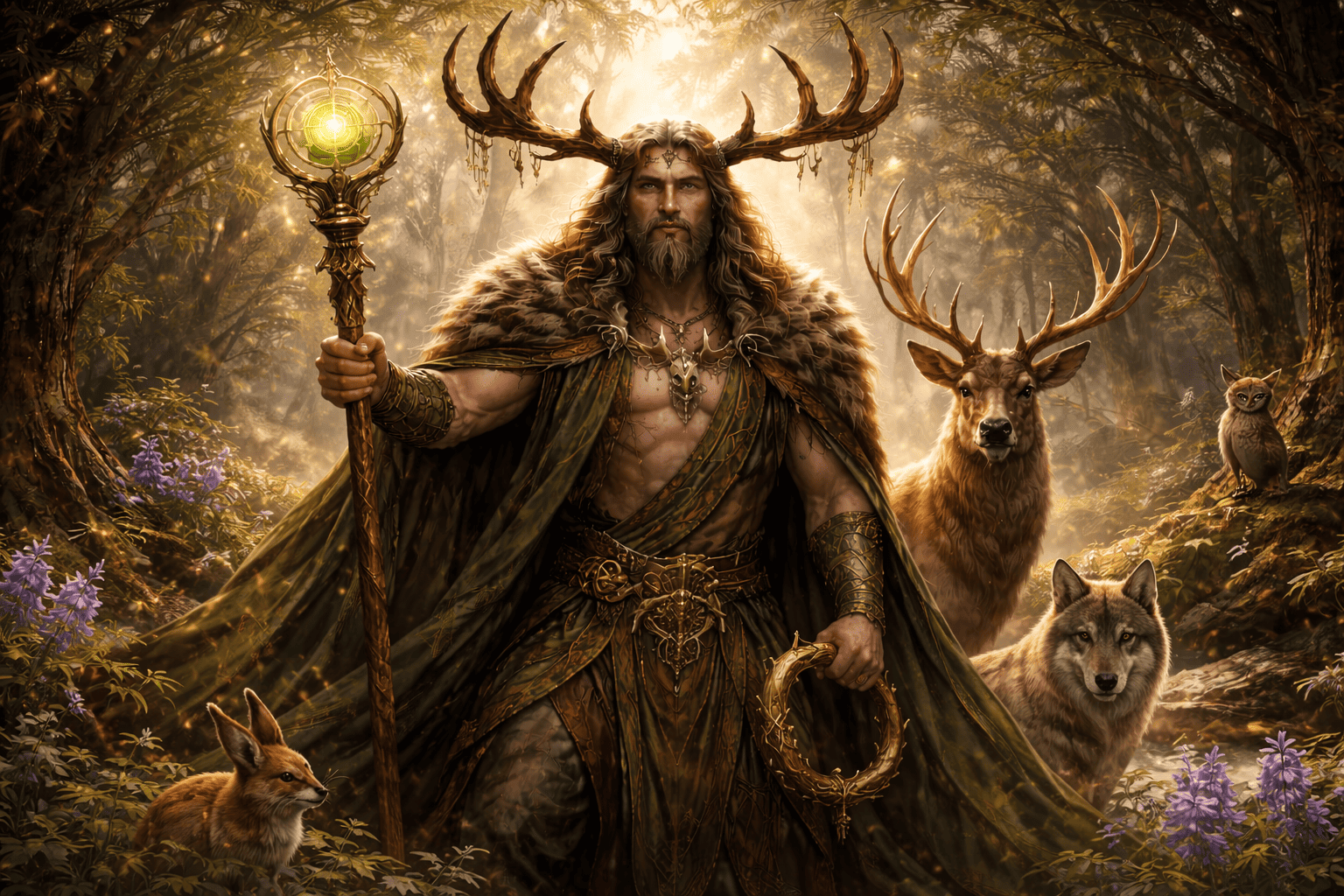
Cernunnos is one of the most intriguing figures in ancient European myth—familiar enough to recognize, yet mysterious enough to invite questions. Often called the cernunnos horned god, he appears not as a distant ruler on a throne, but as a quiet power of forests, animals, and the in-between places where civilization meets the wild. Unlike many well-documented deities, cernunnos survives in fragments: a few images, a handful of inscriptions, and a long echo in later storytelling. That partial record is part of his appeal. He feels less like a fixed character and more like a living symbol—of nature’s abundance, of cycles that cannot be controlled, and of the awe people feel when they stand beneath old trees and realize the world is much larger than human plans.
Cernunnos in the Celtic World
When people say celtic god cernunnos, they’re usually pointing to a deity associated with Gaulish and broader Celtic religious traditions. The most famous depiction comes from the Gundestrup Cauldron, where he sits cross-legged, antlered, surrounded by animals. This image suggests a figure who doesn’t dominate nature by force; instead, he belongs to it, holding it together through presence and balance. The phrase celtic cernunnos is useful because it frames him within a web of local beliefs rather than a single standardized “mythology book” version. In many ways, he represents how Celtic religion often worked: rooted in place, shaped by tribe and landscape, and expressed through symbols more than long written epics.
Symbols of the Horned One
The antlers are the first thing most people notice, and they do heavy symbolic lifting. Antlers grow, shed, and return—an annual rhythm that mirrors the turning of seasons. That alone makes cernunnos feel like a guardian of cycles: life, loss, renewal. He’s also frequently shown with a torc (a metal neck ring linked with status and sacred power), hinting that this is not merely a “forest spirit,” but a cernunnos deity connected to prosperity and sovereignty in a deeper, more elemental sense.
Another common companion is the serpent, sometimes depicted with ram horns. Rather than reading this as purely sinister, it can be seen as a sign of earth-energy—things that move under the surface: roots, burrows, hidden waters, the unseen forces that keep life going. Together, antlers, torc, and serpent create a portrait of power that is grounded, physical, and quietly commanding.
Wilderness, Wealth, and the Web of Life
It’s tempting to reduce cernunnos to a single “god of the forest” label, but his imagery suggests a wider range. The animals around him—stags, boars, wolves, even cattle—represent both untamed wilderness and the resources people depended on. That makes him a figure of abundance, but not the easy kind of abundance that comes without responsibility. If he is tied to wealth, it’s the wealth of ecosystems: healthy herds, fertile ground, balanced seasons, and the respectful harvesting of what the land offers.
This is why modern interpretations often see cernunnos as a reminder that nature isn’t just scenery; it’s relationship. In that sense, he can stand beside underworld myths without being an underworld god himself. Consider the way hades persephone stories revolve around cycles of descent and return—how life above ground depends on what happens below. Cernunnos, too, speaks to the truth that growth is inseparable from shadow, and that renewal often follows a period of stillness.
Why Cernunnos Still Resonates
Part of cernunnos’s modern popularity comes from how open-ended he is. With fewer fixed tales, he becomes a mirror for what people feel they’ve lost: connection to land, respect for animals, attention to seasons, patience with slow change. Yet his message isn’t only nostalgic. As a symbol, cernunnos can be read as an invitation to re-balance—to see humans as participants in a living system rather than owners of it.
In a world of constant noise, the horned figure seated among animals suggests a different kind of strength: steadiness. Not conquest, but coexistence. Not domination, but belonging. Whether you approach him as myth, archetype, or sacred memory, the enduring fascination with cernunnos deity imagery shows how deeply people still crave stories that make the natural world feel enchanted—and ethically meaningful.
Conclusion
Cernunnos endures because he occupies a powerful middle space: ancient yet adaptable, wild yet wise, distant yet strangely intimate. As celtic cernunnos imagery shows, he is not simply a character in a single tale, but a symbol stitched into landscape and season. The antlers, the animals, and the torc point toward a worldview where prosperity and wilderness are not enemies, and where life’s cycles deserve reverence. Even without a library of surviving myths, cernunnos remains vivid—an emblem of the living world’s mystery, and a reminder that what sustains us is often older, deeper, and quieter than we think.